
Love Armor Project
Love Armor
Project
Conceived January 2007 — Premiered September 6, 2008 — Ongoing
Overview
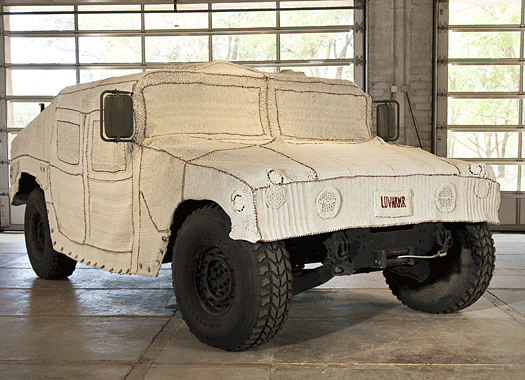
A nationwide collaborative artwork in which over 70 knitters and artists from across the country created a knitted cozy for a Humvee M1026 — 15′ × 7′ × 6′ — transforming a war icon into a symbol of peace and hope. The work premiered at the Center for Contemporary Arts, Santa Fe, New Mexico, September 6, 2008, and has traveled and continued to evolve.
Origin
The Love Armor project began as a means to show concern for both our military and the civilian populace in the war zones of Iraq and Afghanistan. A statement of purpose and an invitation to participate in this huge collaborative project was sent out to knitters and artists in 2007. Our challenge was to transform a war icon into a symbol of peace and hope.
Artist Statement
January 2007, having been outraged by what I read in the NY Times about our troops not being properly protected on the roads in Iraq & Afghanistan, I started conceptualizing my Love Armor Project, a nationwide collaborative project, to show concern and compassion. Realized in 2008 through the participation of over 70 artists and knitters from across the country, it premiered in Santa Fe, NM and traveled. We brought people from all walks of life together with a "unified humanist voice".
From the Archive

Project Development
In 2007, Shirley Klinghoffer sent a statement of purpose and an invitation to participate to knitters and artists across the country. The challenge: to transform a war machine into an object of care, comfort, and collective voice.
Over 70 contributors responded. The resulting work — a full-scale knitted cozy for a Humvee — became both a sculptural object and a community act, premiering at the Center for Contemporary Arts, Santa Fe, in 2008.
Artist Statement
The Love Armor project began as a means to show concern for both our military and the civilian populace in the war zones of Iraq and Afghanistan. A statement of purpose and an invitation to participate in this huge collaborative project was sent out to knitters and artists in 2007. Our challenge was to transform a war icon into a symbol of peace and hope.
The Love Armor represents the work of over 70 participants nationwide. As of September 2, 2008, the Humvee cozy (15′ × 7′ × 6′), our central image, was completed. It premiered on a Humvee M1026, delivered by the New Mexico National Guard. On September 6th, our Love Armor reception, in the 6,000 square foot Muñoz/Waxman Gallery at the Center for Contemporary Arts, set a record for the largest attendance at a CCA (Santa Fe) opening.
On September 11th, in a Community Ceremony, the Humvee was brought home by the National Guard; and the cozy was transferred, with reverence and care, to an armature — where it floated as a symbol of peace and hope.
We see this as the beginning of a journey for the Love Armor project to be shown in venues around the country. Although the LAP is timely in many ways, it is also "timeless" in its broad message — bringing people together with a humanist voice. Our aim is to continue to promote interest in bringing this project to galleries, museums, alternative spaces, and educational environments. Because of the timeless aspect, we hope to be considered for exhibitions in the future (as we know many venues plan years in advance).
We would like to meet with any interested directors and curators to discuss some ideas for educational outreach and interactive programs, along with the visual presentation. One of our goals is to raise awareness of the importance of community service, especially for young people. The Love Armor project provides a great catalyst for dialogue.
— Shirley Klinghoffer, October 2008
Curator's Statement
The Love Armor Project is the result of the ardent will and indefatigable conviction of a single artist in a generous and talented national community ready for action, hard work, and change. When I first discussed the prodigious concept of The Love Armor Project with artist Shirley Klinghoffer and collaborating artist Sarah Hewitt in the spring of 2007, it struck me as an extraordinarily ambitious, unwieldy, and compelling undertaking. Shirley aspired to create a network of artists, knitters, and friends to knit a fifteen foot “cozy” for a Humvee M1026—a war vehicle currently employed in both Iraq and Afghanistan—as a demonstration of peace, forgiveness, and hope. The idea seemed sublime both in scale and concept and I assured her that if this project ever came to fruition the Center for Contemporary Arts would proudly host its debut. As we further discussed the massive knit white object that would softly envelope one of the most iconic symbols of the modern American Army, my mind unintentionally strayed to the archetypal grandmother’s kitchen where carefully handmade cozies swathe teapots and toasters, ready at a moment’s notice to comfort a skinned knee, a feverish child, a broken heart. This absurd image somehow magnified the projects potential to compel audiences in surprising and unexpected ways. The idea of a hummer cozy is as ridiculous as it is comforting and I knew that properly realized The Love Armor Project could be both an artistic tour de force and an undeniably solemn social critique. With references to feminist textile and anti-war art of the 1960’s and 1970’s by such iconic artists as Louise Bourgeoise, Magdalena Abakanowiz, and Judy Chicago, the Love Armor Project deviates from its precedents in deliberate social inclusion and gentle forgiveness. The cozy stems from a medium and tradition of domesticity and comfort. Knitting is a meditative and reflective process—a coming together of people, lives, and stories. The participants of the Love Armor Project—male and female and ranging in age from 6 to 82—plaited skills, patterns, and experiences to weave new narratives, offer solace, and to become a part of a project larger than the sum of its individual participants. When the Love Armor Project debuted in New Mexico in September 2008 it exceeded all expectations. The cozy and its subsequent documentary films, photographs, letters, and site-specific musical performance awed Santa Fe audiences. The US military stunned us all by not only agreeing to allow a Humvee to be measured and fitted for the cozy patterns, but to loan the Center for Contemporary Arts a Humvee M1026 for a week of the exhibition. The New Mexico National Guard drove the massive vehicle into the exhibition space while CCA patrons, artists, military personnel, and members of the press watched. The attendant members of the military, male and female veterans of Iraq and previous wars, seemed proud and touched to have this object of art and symbol of hope draped over their massive war machine. At the end of the week, the Humvee returned to the National Guard and the cozy hung suspended in the 6000 square foot exhibition space. Without an object to envelope, the cozy became a mute testament to loss and hope. As art critic Jon Carver stated in his review of the Santa Fe exhibition, “Milan Kundera called it ‘the laughter of angels,’ when something lifts and unburdens your heart finally, after a long time of despair. The floating cozy, after the Humvee M1026 was driven out, achieved this lifted elegiac emotion via presented absence.” The Love Armor Project impacted Santa Fe in a singular and profound way. Its debut exhibition space, The Center for Contemporary Arts’ Muñoz Waxman Gallery, was built during World War II as a tank repair station. In 1941, over 800 New Mexico soldiers were sent to the Philippines as members of the 200th Coast Artillery Regiment. While there, the soldiers were overwhelmed by the Japanese and forced to endure the notorious Bataan Death March and subsequent internment as prisoners of war. Only one-half of these young men returned home three and a half years later. The Love Armor Project is not only about war in Iraq and Afghanistan; it is about recognizing and honoring all war wounds past and present. The Love Armor project offers a simple and impressive proposition—a world of community, unity and compassion. The Love Armor Project received letters of support from men and women in active military duty, veterans for peace, mothers of lost soldiers, and adamant anti-war protestors. These disparate groups stood side by side when the Humvee arrived and again as it departed. In these brief moments of grief and remembrance everyone stood together in silent accord. The Love Armor Project is an intricate homage to men, women, and children of all eras and nationalities. As a symbol of our delicately intertwined lives and destinies the Love Armor Project holds within its threads the promise of community, compassion, and change.
— Cyndi Conn, Director, Center for Contemporary Arts, Santa Fe, 2008
Critic Review
Mothball the military industrial complex. Shirley Klinghoffer and Sarah Hewitt had better keep on knitting. Knitting their brows because this last little art intervention of theirs was a real humdinger. Or maybe we should let 'em relax for a while, maintain their poker faces and just admit to ourselves — the ante has been upped.
Getting knitting forms the plan, so the work broadcasts immediately deep-dish, Chicago-style feminist collaboration of the "women's work as high art" variety that we've all come to love. But since it's 2008 and since both genders knit, and everybody can be a Marine, and it's Santa Fe, and the mistaken occupation of Iraq still sucks, Love Armor transforms the Waxman Gallery into a deconstruction site that posits itself successfully as both a theoretical and social action, a genuine act of peace, love, and understanding.
Getting the National Guard to bring a camo-painted Humvee to cuddle and cozy (because sharing is caring) into the former tank armory at the CCA is a hilarious idea. The floating Humvee Cozy has all the classical conceptual elegance of a well-played and well-intended joke, à la Duchamp or Manzoni. In realization it provides the anti-gravity to enact the psychic deconstruction process that is grief.
The Love Armor Project posits an off-white site within a black hole, a still place to honor the 4,000-plus American lives lost in Iraq, many in or around this Humvee, our standard issue military vehicle. The cozy transforms itself into a shroud for those who never got out. The L.A.P. intercedes, nurtures, and as a laying-on-of-hands it offers healing and protection.
Knitting is a meditation akin to enumerative prayer, akin to chanting, akin to mother wailing — a father's tears, one after another. Milan Kundera called it "the laughter of angels," when something lifts and unburdens your heart finally, after a long time of despair. The floating cozy, after the Humvee M1026 was driven out, achieved this lifted elegiac emotion via presented absence.
My recommendation: immediately contract eighty-five percent of our designers and manufacturers of weaponry to work as artists exploring their deepest imaginations.
— Jon Carver, THE Magazine, November 2008
Shirley Klinghoffer's Love Armor Project is a present-day true-to-life ghost story. It is also, as are most ghost stories, a story of war and love. Working with the New Mexico National Guard, Klinghoffer took detailed measurements of the Humvee model M1026 — not your slick gangster-style ride, but the actual model currently employed at war in Iraq and Afghanistan — in order that a team of knitters and seamstresses, facilitated by collaborator Sarah Hewitt, could create a life-sized (15′ × 7′ × 6′) fitted cozy of the military vehicle.
Over the course of several months, more than 70 participants knit and stitched individually and at numerous "Love-Ins." The result is The Love Armor cozy. Klinghoffer's cozy serves as armor, standing in as protection for our soldiers in service to their country. Like a shroud turned into a bridal veil, the artwork offers defiant beauty where soldiers and civilians alike have found grief and horror.
The Humvee is to be driven into the 6,000-square-foot Muñoz Waxman Gallery at Santa Fe's Center for Contemporary Arts. Ironically, the gallery once was a tank repair station for the Guard, which sent 1,800 New Mexico soldiers to the Philippines during World War II. The men, members of the 200th Coast Artillery Regiment, were overwhelmed by the Japanese and forced to endure the notorious Bataan Death March and subsequent internment as prisoners of war. Only one-half of these young men returned home three and a half years later in 1945.
After the Humvee enters the gallery, it will be fitted with the cozy. On Thursday, the seventh anniversary of the tragedy known as September 11th, the vehicle will be driven out of the gallery, leaving behind its ghost: the cozy floating eerily, poignant with the meaning and empty of substance. Absent the actual Humvee, can its ghost of sewn and knotted cords, a version of "women's work," heal the wounds of war, past and present? Will Klinghoffer's compassionate act of love reveal the scars of violence, soothe the abrasions of hate?
So long as one human is defiled or killed in an act of war, the ghosts of our loss must continue to haunt us. And artists will work with what is at hand, creating beauty out of sheer survival.
— Kathryn M. Davis, art historian
Video Documentation
Exhibition and Presentation History
Love Armor (collaborator Sarah Hewitt)
Center for Contemporary Arts (CCA), Munoz/Waxman Gallery, Santa Fe, NM
Love Armor
Crane Arts / Ice Box Project Space, Philadelphia, PA
Love Armor
Brenda Taylor Gallery, New York City
Love Armor 10th Anniversary Exhibition & Community Outreach Program (in collaboration with New Mexico Arts & the Military)
Center for Contemporary Art, Santa Fe, NM
Press
Fiber Arts Magazine
"Love Armor Project" — Kathaleen Roberts.
THE Magazine
"The Love Armor Project" — Jon Carver.
Americans for the Arts
"The Arts Say Thank You to Our Veterans and Active Duty Military" — Robert L. Lynch.
Read →Photography credit to be confirmed. All images © Shirley Klinghoffer.
© Shirley Klinghoffer, Santa Fe, New Mexico. All Rights Reserved.